Concepts
Concepts
Kubernetes does not restart your workloads when a Secret or ConfigMap
they consume changes. KICK closes that gap. It watches a workload’s
dependencies, detects when one changed after the last rollout, optionally
asks your GitOps tool for permission, and then issues exactly one controlled
restart.
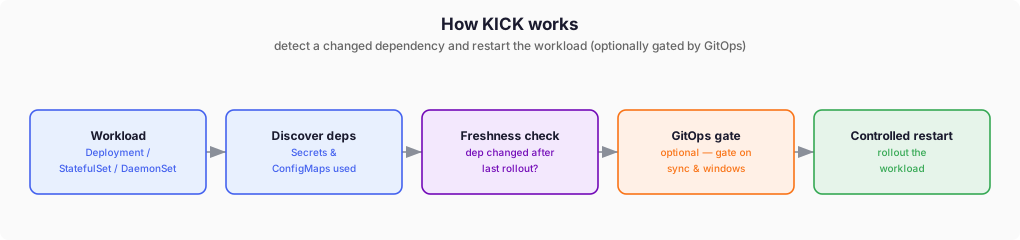
The pipeline
Every restart decision follows the same four steps. Each concept page below covers one of them in depth.
| Step | What happens | Concept |
|---|---|---|
| 1. Detect the gap | A Secret/ConfigMap changes, but the running Pod keeps its old config. | The hidden restart requirement |
| 2. Discover deps | Find the Secrets and ConfigMaps the workload consumes via env and volumes. imagePullSecrets are excluded. | Dependency discovery |
| 3. Check freshness | Compare the latest dependency change against the current rollout start. Newer dependency = stale = restart needed. | Freshness |
| 4. Gate the restart | If a provider or windows are configured, restart only when the owner is in sync and the window is open. | GitOps gates |
By default (no gitOps provider) step 4 is a no-op and KICK restarts as soon as
a workload is stale.
Why changing a Secret or ConfigMap silently drifts your Pods.
How KICK finds the Secrets and ConfigMaps a workload consumes.
How KICK decides a running rollout is stale and needs a restart.
How native windows and a GitOps provider gate the restart.
For the same model in formal notation, see the
operator model. The diagrams are editable draw.io
SVGs (docs/static/images/*.drawio.svg) — open them in
draw.io to edit, then save in place.
Last updated on