GitOps gates
A gate decides whether a restart that is needed (the workload is stale) may actually run right now. The gate never invents work: it only ever delays or permits a restart that freshness already justified.
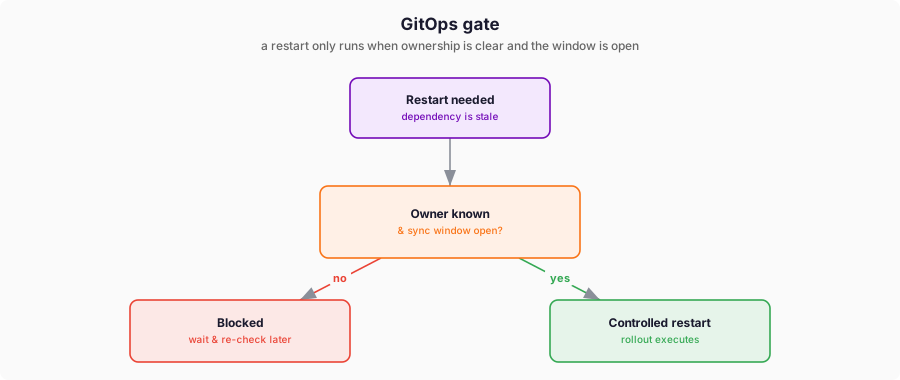
Gating is opt-in. With no gitOps block — the default, provider: None —
KICK self-gates and restarts as soon as a dependency is stale. You add a gate
when a restart must wait for a maintenance window, or until your GitOps tool has
finished reconciling the workload.
Two stages
The gate is evaluated in order. A restart runs only if both stages allow it.
stale workload ──▶ [ 1. native windows ] ──▶ [ 2. GitOps provider ] ──▶ restart
                          │                            │
                     OutsideSchedule            sync window · owner · sync state
                          ▼                            ▼
                     wait & re-check              wait & re-check
Stage 1 — native schedule windows
spec.schedule.windows[] are KICK-native cron windows evaluated without
any provider. Each window is either Allow or Deny:
- The current time is open when it falls inside at least one
Allowwindow and inside noDenywindow. - Deny always wins. A
Denywindow overlapping the current time blocks the restart even if anAllowwindow also matches. - With no windows configured, this stage is always open.
When the clock is outside the allowed schedule the gate blocks with reason
OutsideSchedule and re-checks when the next window boundary arrives.
Each window takes a 5-field cron expression, a duration, and an optional
IANA timeZone (UTC by default). This stage never consults a GitOps tool, so a
maintenance window works on its own.
Stage 2 — GitOps provider
spec.gitOps.provider selects who owns the restart decision:
| Provider | Behaviour |
|---|---|
None (default) | KICK self-gates; this stage always allows. |
ArgoCD | Defer to Argo CD ownership and sync state. |
Auto | Detect the managing provider automatically. |
Flux | Reserved for Flux ownership (roadmap). |
With a real provider, KICK must resolve exactly one owner for the workload and confirm that owner is reconciled before it restarts.
Owner resolution (Argo CD):
- Primary — the workload’s Argo CD tracking annotation.
- Fallback — an indexed lookup of
Applications that manage the workload. - Zero or ambiguous — no owner (
OwnerUnknown) or more than one (MultipleOwners) blocks the automatic restart. KICK never guesses.
Sync windows — the Argo CD provider also evaluates spec.syncWindows on the
AppProject that owns the Application, using the application name and its
destination. A closed window blocks with OutsideSchedule, the same reason the
native stage uses. So Argo CD sync windows are honoured without restating them
in the KickPolicy.
Sync check — when requireReconciled is true (the default), the owning
Application must report Synced. An out-of-sync or still-reconciling owner
blocks with OwnerOutOfSync / OwnerReconciling, so KICK never restarts against
config the GitOps tool is mid-flight on.
Blocking reasons
The gate surfaces why a restart is waiting on KickRequest.status.gate.reason:
| Reason | Stage | Meaning |
|---|---|---|
Allowed | — | Both stages passed; the restart may run. |
OutsideSchedule | Windows | Current time is outside a native window or an Argo CD sync window. |
OwnerUnknown | Provider | No GitOps owner could be resolved. |
AmbiguousOwner | Provider | More than one owner matched. |
OwnerOutOfSync | Provider | The owning application is not Synced. |
OwnerReconciling | Provider | The owning application is still applying. |
ProjectUnknown | Provider | The application’s AppProject could not be read. |
ProviderUnavailable | Provider | The provider could not be queried. |
ConfigurationError | Provider | A sync window could not be parsed. |
Waiting behaviour
A blocked restart is not dropped. KICK persists the waiting phase and reason on
the KickRequest and re-evaluates the gate when either:
- a timer fires (to catch schedule-window boundaries), or
- a relevant provider object changes (for example the
ApplicationbecomesSynced).
The moment the gate flips to Allowed, KICK re-reads live state and — if the
workload is still stale — issues the restart.
Example
Restart only inside a nightly window and only once Argo CD has synced the owner:
apiVersion: kick.corewire.io/v1alpha1
kind: KickPolicy
metadata:
  name: gated
spec:
  discovery:
    workloadSelector: {}
  schedule:
    windows:
      - type: Allow
        cron: "0 2 * * *"   # 02:00 daily
        duration: 1h
  gitOps:
    provider: ArgoCD
    requireReconciled: true
Native schedule.windows gate when KICK restarts; they are independent of the
provider. Argo CD AppProject sync windows still constrain when Argo itself
syncs, and the Argo provider honors them as part of its own gate.
See also
- Freshness — what makes a restart needed before the gate runs.
- KickPolicy reference — every
gitOpsfield. - Operator model §6 — the gate in formal notation.